Some animals eat until they are full and then just stop. They don’t take more than they need. Maybe they evolved in an environment where there was always enough food, so it was advantageous to have an internal gauge of satiety to avoid taking in too much. Other animals keep eating and eating, as though they don’t know where their next meal is coming from. They eat more than they need to keep a reserve of energy in case food becomes scarce or sporadic.
Humans are somewhere in between, and we can vary widely along this scale. We can graze or binge, and many people do both.
Economies that rely on continuous growth and increasing consumption have long been criticised. Most of us understand that greed is NOT good and that too much can become too much. But our collective understanding of what is sufficient for us is less well established. Some environmental researchers have tried to identify a safe and healthy band of sufficiency between the minimum societies need to survive and flourish, and the point at which overconsumption becomes dysfunctional. It turns out that this is a really hard thing to figure out.
I was struck by something I read by in Black Paths and Green Cathedrals.
“define your own ‘enough’. Not society’s version, not what the adverts tell you, not the ‘success’ sold to you in magazines, but your personal, soul-deep enough.”
I think this gets to the heart of the problem. We have to figure out our own sense of sufficiency as an antidote to dangerous overconsumption. It doesn’t seem to be entirely innate, and it’s certainly not always instinctive for us to stop taking more than we need.
Addiction is a good example. Although it’s not easy and some people have to call on the help of a higher power, some forms of addiction can be completely turned off – like turning off the water in your house at the mains tap if there’s a leak. This is because you really don’t need certain addictive things in your life at all. They are not a wholesome aspect of human life. You don’t need to gamble, you don’t need to smoke crack. So it is possible to completely cut these things out of your life, and after an initial crisis, life can return to balance.
Of course, with certain substances like alcohol or benzos, it can be more complicated than that. If your body is very used to them, you may be physically dependent, and stopping abruptly can be very dangerous. Even then, it is possible to undertake a managed withdrawal, turning the mains tap off slowly rather than all at once, and eventually eliminating that substance from your life completely if needs be.
Sometimes it’s not as straightforward as switching off the mains, fixing the leak, then turning the supply back on. If you have been properly addicted to something, you may have permanently altered your nervous system to the extent that returning to safe use is difficult or impossible. At the very least, there may be a significant risk in trying to return to casual use. Some people have to go round the Wheel of Fortune many times before they accept this. The grooves and channels remain, and if you let the substance back in, things can unravel quite quickly. In those cases, complete abstinence may be the answer.
But other forms of addiction are not so simple. Eating is the obvious example, and sex probably belongs in the same category. These are natural drives and aspects of a healthy human life. You tend to make yourself unwell if you try to abstain completely, certainly in the case of food. As Dion Fortune observed, it is better to have a perverted will than a repressed will.
With this sort of addictive behaviour, the problem is not solved by elimination. The challenge is to stay within a zone of ‘sufficiency’ – recognising when enough is enough. We need to maintain awareness of our level of use within the cognitive loop and recognise our own green, amber, and red zones. Green is fine. Amber is a warning to be careful. Red is too much.
In the Sphere of Foundation, or Yesod, on the Kabbalistic Tree of Life, there is a traditional association with this idea of sufficiency. There is a sense that, behind the scenes, reality is weaving itself together in mysterious ways that provide us with what we need. There is an obligation to trust in the sufficiency and self-righting nature of existence, and to cultivate awareness of the deeper reality that underpins physical life.
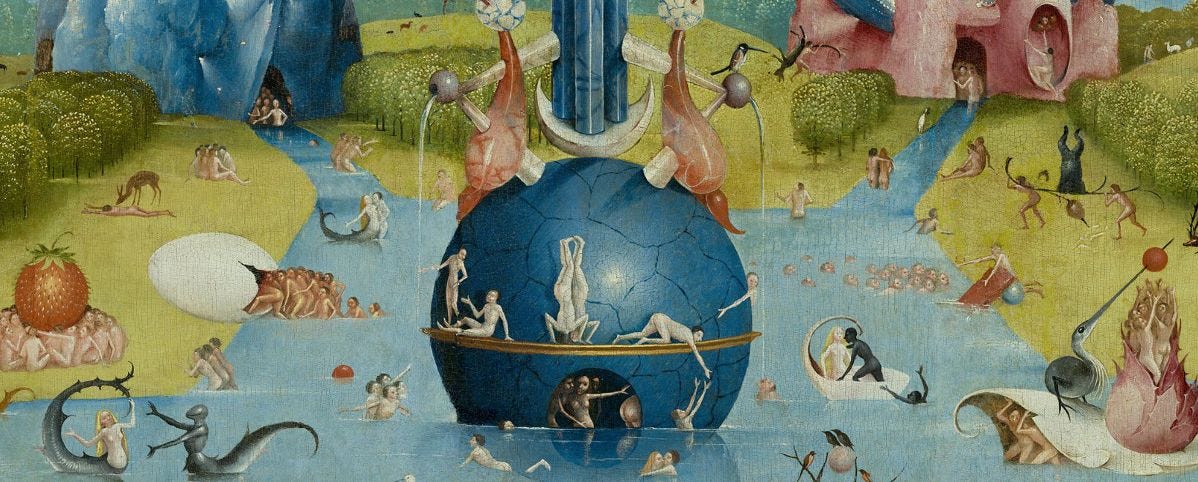
Foundation is like the stream flowing from the river that nourishes the Garden of Eden. To experience Foundation fully, we must trust that we will receive what we need without grasping for it.
A lot of compulsive consumption stems from anxiety. We worry that we won’t be able to cope with situations, feelings, or even the present moment without the external thing. Another drink. Another purchase. Another helping. Another distraction. We become convinced that we need it. But of course we can cope.
Perhaps defining ‘enough’ is ultimately an act of trust. Trust that there will be enough. Trust that we are enough. And trust that we can let go of things that once seemed indispensable without losing ourselves in the process.