All Posts

  • On making incense

    Duncan Fleming 8/8/2026

    Beyond luxuriating in pleasant fragrances, certain aromatic resins, herbs, oils, and other ingredients are traditionally associated with aspects of the Divine. Incense burned on charcoal can purify space, evoke particular energies, and improve focus during ritual. Our sense of smell evokes deep memories and can more readily bring us back to a previous state of consciousness, especially when the same scents are used repeatedly in a particular context.

    Good Sephirotic incense blends are hard to find. Trevor Jones made excellent incense, sold in Glastonbury, and Sorcerer’s Apprentice in Leeds also produced interesting Sephirotic blends – perhaps they still do. Towards the end of the twentieth century, I was advised to write to the reclusive Margaret Bruce, who had largely retired but was still supplying her remarkable incense by post to existing customers. I bought several of her ‘Qabalah’ blends, which I used for many years in personal practice and group work. (See The Magick and Mystery of Maurice/Margaret Bruce by for a fantastic account of her life and work.)

    Margaret Bruce ‘Qabalah’ incense

    What is remarkable is that these incense blends retained both their fragrance and their potency for decades. Margaret Bruce extolled the virtue of leaving her incense to steep for several years, on the basis that incense blends, like whisky or wine, improved with age. Sadly, when she died, her recipes appear to have been lost to the mists of time. I have concluded, with independent advice, that her blends were exceptionally complex and could not be reproduced in practice.

    Like the ashes of the Red Heifer, once they are gone, they are gone forever. So the only thing to do was start again from first principles. In much the same way that it is usually better to make your own magical tools, even if they are not as slick or professionally finished as something bought off the shelf, they benefit from having been crafted by you. The process of making them is a magical act of will in itself, and I think the same is true of incense.

    Crafting your own incense for ritual use does require careful observation, patience, and plenty of trial and error. It is as much a practical craft as a symbolic one, and understanding how aromatic materials behave in real-world conditions is essential to using them effectively.

    A word of warning about traditional correspondences. Biblical, Agrippa, and Crowley’s 777, etc., all provide useful hints, but they shouldn’t always be taken as definitive recipes. Sometimes the exact botanical or animal product referred to is uncertain. Sometimes it may no longer exist, or only a particular plant strain produces the aromatic extract originally intended.

    Take Dittany of Crete, for example, traditionally associated with the Sephirah Malkuth. It is an aromatic herb, but when burned it just smells like a bonfire. It’s pretty much unusable in incense, except in the tiniest pinch, simply out of respect for the correspondence. It does, though, produce a great deal of thick smoke, and there may be some association with making spirits visible in the rising plumes. Personally, I think that connection is tenuous, as there are other, much better-smelling substances that produce just as much smoke.

    When I first started making incense, I accumulated quite a collection of books. They were a useful starting point, but I would take many of the published recipes for Sephirotic incense with a huge pinch of salt. Some books contain hundreds of formulas, and one has to wonder whether the author has really spent time testing each one. It is all too easy to throw together an incense by following correspondences that make sense on paper, but does it actually smell good? I have tried some that were theoretically right but, in practice, were really horrible.

    There’s also a temptation to think that the rarer and more exotic the ingredients, the more profound the result will be, which I don’t think is true. Every ingredient has a cost, not just financial. Frankincense, myrrh, and other resins are the dried tears of wounded trees, sometimes sourced from war-torn regions. The quality of ingredients varies enormously, though there can be a certain amount of snobbery, as though only one impossibly rare variety will do. It is also worth remembering that some aromatic substances simply do not agree with everyone. Not necessarily because of full allergies, but because of unusual physical reactions. They might make some people sneeze or make their eyes sore. That is not what we want during group work.

    Some traditional incenses also use animal products such as ambergris, produced by sperm whales, and musk. I once accidentally bought a small amount of castoreum for a recipe before discovering it comes from beavers’ scent glands. It is certainly very pungent and adds a persistent animal note to a blend, but I won’t be buying it again.

    Asafoetida is another interesting ingredient. On its own, it smells repugnant, but in tiny quantities it seems to work like MSG in cooking, adding a punch that brings out the other ingredients. Traditionally, it is associated with dispelling unwanted or unredeemed spirits, and you can tell why when you use too much.

    Finding ingredients is so much easier now than when I first began, thanks to internet shopping, although there is still no substitute for buying them in person if you can. Being able to see and smell the raw materials before buying them tells you a great deal. My favourite place remains Star Child in Glastonbury, which consistently stocks good-quality raw ingredients. I have used their individual ingredients for years, although I have much less experience with their pre-mixed incense blends.

    I’m particularly interested in Sephirotic incense, since Kabbalah is central to my working tradition. They are not exactly the same as the planetary correspondences associated with the Sephiroth, although there is some overlap. I have been working towards creating a set of Sephirotic incense recipes, and this is what I have learned.

    The aromatic gum forms the foundation. Essential oils, herbs, spices, or seeds may be included, but the main body of the incense will usually consist of one of the principal resins: frankincense, myrrh, opoponax, and so on. In practice, there is often surprisingly little essential oil or herb in the finished blend.

    Like a liquid perfume, blended incense benefits from having top, middle, and base notes. The brighter top notes usually come from essential oils, but they also disappear first when heated. As a general rule, the longer a blend is left to mature, the more thoroughly the oils combine with the other ingredients and the more gradually they are released, rather than simply burning off in the first few seconds. You can also, to some extent, control how quickly the incense burns by adjusting the size of the resin pieces and degree of grinding for other ingredients. Crushing them more finely with a pestle and mortar increases the combustible surface area and alters both how the fragrance develops and how quickly it burns.

    Whenever I make a new blend, I prepare very small test batches, no more than a teaspoon in total, and burn them on a single charcoal disc. I take notes, adjust the proportions, and try again. It sometimes takes half a dozen attempts, or more, before I arrive at something practical, pleasing, and genuinely evocative of the Sphere it is intended to represent.

    There is also the more complex question of how the individual Sephirotic incenses work when combined together. Ideally, they should harmonise when used in pairs or triads. I want them to chime together like different instruments in a piece of music, complementing rather than competing with one another. No single fragrance should dominate the others.

    I am by no means an expert. I can only share what basic practical experience has taught me. Use your hands and your nose, and experiment – a lot. Trust your senses and your intuition. Keep a notebook and fill it with observations, however strange they may seem. Record what ingredients smell like when they burn, because this is often very different from how they smell at room temperature. Sometimes the most wonderfully fragrant materials become acrid on charcoal, while ingredients that hardly smell at all before burning become quite extraordinary. Adapt and keep refining. Incense making is much more an art than a science. Use your incense as often as you can in ritual. It will gradually become associated with particular states of consciousness, and years later a familiar fragrance can transport you straight back to where you were before.
  • Dr. John Dee’s Actions with Spirits

    How I dislike that title. It relegates the principal author of the spirit actions – I mean of course Edward Kelly – to the role of a ventriloquist’s dummy.

    I am in the middle of one of my periodic reviews of Dee and Kelly. I do this every decade or so. The two principal subjects (plus the revolving cast of spirits) become more and more interesting with the passage of time … as I bring a wizened experience, failing memory, and robust common sense to bear on the raw matter. Expect more posts.

    The raw matter is spread across various manuscripts in the Sloane Collection of the British Library, and the Cotton manuscripts in the British Museum. It is tempting to seek access the originals, but Dee’s handwriting was famously crabbed, and they have been exhaustively studied by people like Christopher Whitby, Meric Causabon, Donald Tyson, Joseph Peterson, Deborah Harkness, Aaron Leitch, and a host of others who will probably not forgive me for not including them in this list. There is an abundance of quality secondary material to work with.

    There are two principal sources. The largest was compiled by Meric Casaubon and published in 1659 as A True and Faithful Relation … I am fortunate to own a facsimile copy. It is available online in several forms, but I would recommend the original at archive.org:

    https://archive.org/details/truefaithfulrela00deej/mode/2up

    The second portion was relatively unknown for many centuries. This was the portion rescued and copied by Elias Ashmole after adventures involving a secret compartment and pies – proper Enid Blyton stuff. There are two important transcriptions by Christopher Whitby and Joseph Peterson. I was curious to know about the differences and asked Gemini:

    Yes, the transcription of Dr. John Dee’s angelic diaries edited by Joseph Peterson (published as Mysteriorum Libri Quinque / John Dee’s Five Books of Mystery) heavily overlaps with the transcription published by Christopher Whitby in his work John Dee’s Actions with Spirits: 22 December 1581 to 23 May 1583.

    Source Material Overlap

    • The Same Manuscript: Both Peterson and Whitby based their transcriptions directly on the same primary source document: British Library, MS Sloane 3188, which contains Dee’s original handwritten records of his spiritual conferences and angelic scrying sessions with Edward Kelley and Barnabas Saul.
    • Chronological Scope: Both works cover the crucial early period of Dee’s angelic workings from December 22, 1581, to May 23, 1583, capturing the foundational material for what is modernly known as Enochian magic.

    Differences in Presentation and Focus

    Joseph Peterson’s Edition: First published in 2003 (and expanded later), Peterson’s edition aims to make the material accessible as a practical and historical sourcebook, building upon earlier independent transcriptions (such as Adam McLean’s 1985 formatting of Peterson’s work) while incorporating fresh translations of Latin passages, footnotes, and annotations.

    Christopher Whitby’s Edition: Originally a 1981 PhD thesis and published in two volumes in 1988, Whitby’s work provides a comprehensive, literal academic transcription of the entire Sloane MS 3188 manuscript alongside extensive historical and textual commentary.

    A copy of Whitby’s original thesis can be found online. Peterson’s Misteriorum Liber Quinque is currently available on archive.org.

    The post Dr. John Dee’s Actions with Spirits appeared first on Hermetic Kabbalah.

  • The High Priestess

    I was going through some files and discovered this image I made last year (for no particular reason). No, it isn’t AI. I use 3D modelling and physically-based rendering, so it is a kind of virtual photography.

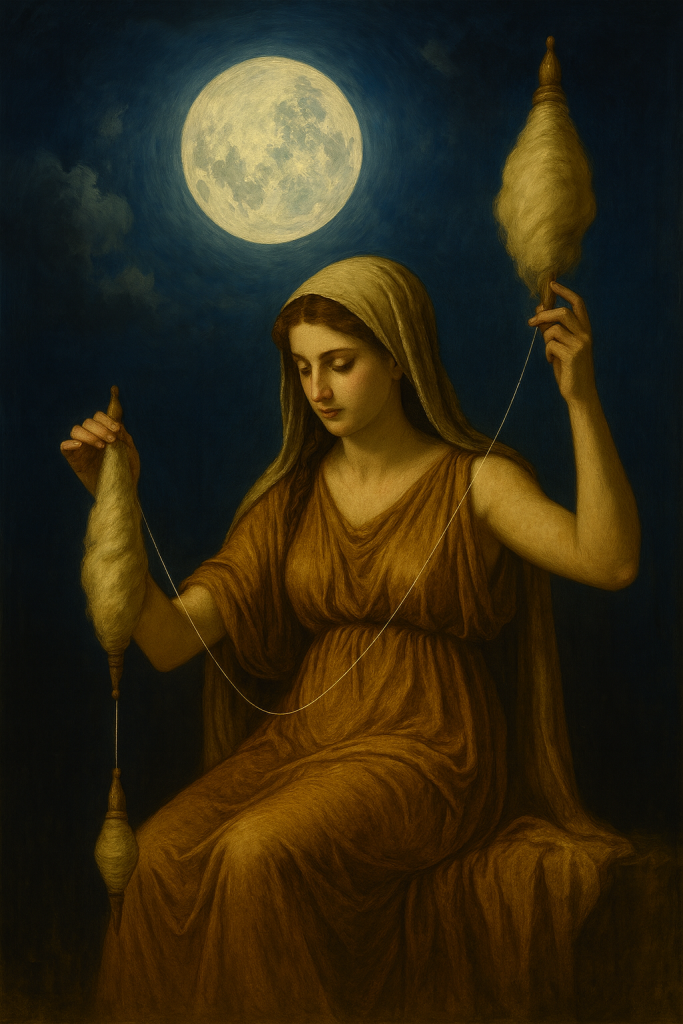
    In the past I have attempted to use AI for images. It works when you want a stereotype image or you aren’t too fussy about the details. Ask it to make an image where it has very few patterns or templates to draw upon and it will produce an image where some parts are polished and other parts are incoherent. I wanted an image of Clotho spinning beneath the Moon (another traditional image found in Tarot) and ChatGPT clearly knew nothing about spinning. The biggest brain in the galaxy didn’t know how to spin a thread. I gave up. (Nice drapes though).

    The post The High Priestess appeared first on Hermetic Kabbalah.

  • Why I don’t charge for teaching

    Duncan Fleming 1/8/2026

    I don’t charge for teaching Kabbalah, and I never have. This is partly because I wasn’t charged for being taught myself. It is a bit like an intergenerational model of care, where you receive something from one generation and, in time, pass it on to the next. This approach lends itself very well to one-to-one teaching, which works rather like an apprenticeship. You work closely with someone for a few years, showing them everything you can about the Tradition, and then they either go on to practise and teach it successfully themselves, or they bail out.


    I started teaching in the late 1990s, and over the years this apprenticeship model has remained the foundation of my practice. It is a traditional model, with an individual teacher and pupil. Sometimes a small cohort approaches for teaching at the same time. If the timing is right, I can teach them some basic theory and practice together and hold small group discussions up to a point. But people learn at different paces. They have their own quirks and special interests, and the one-size-fits-all approach doesn’t really work beyond the absolute basics.

    The tradition I teach uses a graded system, with formal examinations and aptitude tests along the way. This teaching is iterative and needs to build on what has come before, so I need to know that students have a firm footing and can do the basics well before I teach them anything more specific and pokey. Having a higher grade doesn’t mean you have any moral superiority. It is more like learning a martial art or a musical instrument.

    As well as passing on the theory and techniques of practical Kabbalah and ritual magic, including making and consecrating tools and devising magical operations, teaching is about helping people develop a working relationship with the Spheres of the Tree of Life.

    The most important thing people need to learn right at the beginning is how to open up and close down properly. By opening up, I mean entering a vastly expanded, semiotically aroused state of consciousness. Closing down means returning safely to everyday consciousness, with your feet firmly back on the ground. When I’m passing on techniques with practical intensity, I am concerned about aftercare and any subsequent repercussions. Yes, people have to learn from their own mistakes, but some of this stuff can be like dynamite.

    The teaching is not just cerebral theory, or even just theory combined with technique. There is also an emotional, moral, and spiritual aspect to it. When we learn to work with and relate to the Spheres of the Tree of Life, we contact and energise those Spheres within ourselves. We then need to balance and integrate them into our being more deeply than before. Otherwise, we can end up lopsided and distorted, and even more inert, idle, dishonest, selfish, and arrogant than we were before we began.

    Teaching Kabbalah is not psychotherapy. I’ve worked as a psychotherapist, and it’s quite different. It can, however, be an intimate relationship. There is no expectation that a student will bare their soul to you and tell you all their hopes and dreams, but at some point, if they are doing the work with any conviction, things get a bit real. There is a requirement to be more honest about motivations, rather like peeling away the layers of an onion.

    For this reason, the Tradition I teach requires extensive interpersonal contact between teacher and student. That contact is difficult to maintain in a group setting, as the teacher’s attention is divided and each student brings different needs, capacities, and areas of difficulty. Some basic teaching can be done collectively, but the deeper work usually requires a more individual relationship.

    After the very first stages, I think my relationship with a student is more like that of a sponsor in a mutual aid group. Instead of presenting myself as some kind of all-wise hierophant, I can be honest that I am just a person who has been as broken and confused as anyone else by life’s challenges. I have found a spiritual tradition that has been very helpful to me, so I will show anyone who is genuinely interested how it works and help them build the spiritual contacts and personal framework they need to sort out their own mess.

    So why not charge? It would seem reasonable to take a fee for teaching. If I did, I might be able to devote more time to it. But charging is not in keeping with the spirit of the Tradition in which I was raised. It simply goes against the grain.

    That said, I have no objection to charging for items that genuinely cost money to produce, such as books or music. Printing books, recording albums, manufacturing them, and getting them into people’s hands all involve real costs. Teaching, as I understand it, is a different kind of relationship.

    There are other good reasons for me not to charge. When we take money, people quite reasonably expect a product in return. That might be a defined package of teaching, such as a certificate of attendance, or a series of achievement badges, as in the Scouts or Guides. I am keen to emphasise from the outset that there are no prizes. The Crown is hollow. Attainment is an illusion, and the only reward for hard work is more of the same. I don’t want to enter into a transaction with students. I just want to help them and teach them.

    Any projection of the teacher archetype onto me might help in the very early stages, when someone is building enthusiasm and perhaps seeking approval or secret knowledge, but it needs to fall away quickly as we move into the intermediate stages. In my experience, the stronger the projection of the teacher archetype onto a living teacher, the greater the disappointment and resentment when the student realises what they have been doing. As in a Drama Triangle, the rescuer can seem to turn into the persecutor overnight, while the student becomes the victim. When this happens, the student may simply move on, join another group, and seek another teacher, but there is no opportunity to go further until this projection is overcome.

    I also don’t run workshops or weekend experiences. This is not intended as a critique of those who do, as these can be excellent ways for people interested in occult matters to sample different traditions. It is easy to cock a snook at the spiritual marketplace. Of course, there are grifters, as well as eternal joiners who flit from one thing to another without ever getting to grips with the basic ontological and spiritual conundrums of their lives. That doesn’t mean everyone who offers or attends a workshop falls into either category.

    I have also made a commitment to teach in the most inclusive way I can, which means not allowing fees to become a barrier for those who cannot afford them. Of course, it is possible to charge and then say that the fee will be waived or reduced if someone cannot afford it. But there is often stigma attached to that, and it can be very difficult to ask for a fee waiver or reduction when you are hard up. I certainly would not have been able to pay for teaching when I started.

    Still, there are some inevitable expenses. Practical equipment costs money. It is not extortionate, but certain materials may cost a few quid. Unless activities are confined to spare rooms in people’s houses, there will also be costs such as venue hire and travel. These can be handled in the same way as in any small group, with people chipping in what they can, without anyone having to pay subs.

    We started the Rockwax Foundation as a registered charity in 2011 to provide a public face for the teaching offered by me and two other experienced teachers who work closely together within the same Tradition. Charitable status helps with practical matters, such as receiving donations. It also provides a relatively respectable public face and a website. The website has brought in a trickle of enquiries from potential students over the years, serving much the same purpose as a postcard in an occult bookshop did before the internet.

    I suspect this is both the strength and the precariousness of this particular way of teaching. There is no great funnel effect, with a large cohort taught through a weekend workshop or correspondence course, followed by more specialist teaching for those who show greater dedication and interest. The numbers are always esoteric, in the sense that they are for the few. But that’s all right. I only have so many spare hours.

    I also don’t really want to play shopkeeper or sell teaching. Life is complicated enough. I am happy earning money in more straightforward and reliable ways. I don’t need another part-time job.

    The real cost of teaching, of course, is people’s time and dedication. Nobody has to put in the time required for the practical work, meditation, and everything else. But if they don’t, there’s little point in me continuing to teach them, as my time is too valuable to waste on people who are not dedicated. In that sense, there is a cost, but it must be paid willingly. It cannot be paid in advance, only in the present moment, through an ongoing commitment to the Work.

    I nearly didn’t write this because I know quite a few serious and responsible teachers who work in a very different way, and I don’t mean to disparage or criticise them. This is not an argument that nobody should charge for spiritual teaching. It is an explanation of why, for me, teaching must always be free and freely given.

    For more information on the Rockwax Foundation teaching charity, visit www.rockwax.org.uk.

    Thanks for reading! Subscribe for free to receive new posts and support my work.

  • The Smoking Mirror

    In the late-70s I was working in central London and living in a ground floor flat in Stamford Hill adjacent to the Lubavitch. There was almost no heating and ice formed in the toilet. One way to warm up was to drive into the British Museum on a Sunday afternoon, and spend a few hours in relative warmth.

    You could do that in those days … jump in the car, drive into London, and park at the back of the Museum. I doubt that it took more than 20 minutes each way. I would almost always go to the black obsidian mirror attributed to Dr. John Dee and spend some time scrying in it. You could do that too in those days … co-opt occult display items into private sessions without the formality of booking. I think Dion Fortune did something similar in the Assyrian section (see The Winged Bull).

    There is a handwritten note from Horace Walpole: “The Black Stone into which Dr Dee used to call his spirits…”. Over the course of a few years I developed a detailed fantasy about this mirror. It was an Aztec scrying mirror dedicated to the dark god Tezcatlipoca. It was given to Dee as a gift by his friend Sir Walter Raleigh, and was probably looted from the Spanish.

    As it happens, it really is an Aztec mirror. Chemical analysis has identified the mine where the obsidian was found, and you can read about it in this Smithsonian article.

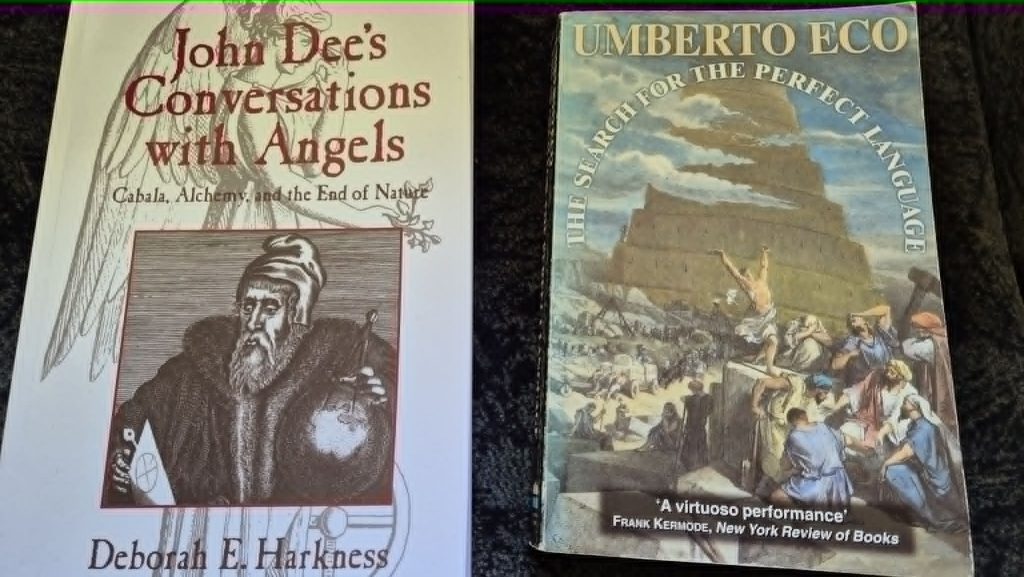
    However … (sadface) … the link to Dee is very circumstantial – see p.30 of John Dee’s Conversations with Angels by Deborah Harkness. According to Harkness, the mirror is never mentioned in the Conversations, while other crystals are. Other than Walpole’s catalogue, there is no evidence the mirror belonged to Dee.

    Nevertheless, obsidian mirrors are A Thing. They are an off-the-shelf item in Glastonbury. I have one myself.

    The post The Smoking Mirror appeared first on Hermetic Kabbalah.

  • The Search for the Perfect Language

    In the 1580s, John Dee and Edward Kelley conducted many remarkable conversations with several angels. Most of Dee’s original records and diaries survive and have been widely reproduced in editions and commentaries, from the famous 1659 A True and Faithful Relation of Meric Causabon, to the fastidious textual analysis of Aaron Leitch in The Angelical Language. There is even a dictionary of the angelical speech in The Complete Enochian Dictionary by Donald Laycock.

    These conversations demand a meta-analysis. What was the cultural and social background that determined the specific form of the communications? What works, accessible to both Dee and Kelley, seem to have influenced the content of the angel’s concerns? Why do the angels communicate in good, everyday English but also have another language, a special language? An overview can be found in the excellent John Dee’s Conversations with Angels by Deborah Harkness

    Something that has always interested me is the presumption that the angels speak their own language. They can converse in English, but in private they would seem to converse in a speech called Enochian. Or perhaps they provide Enochian as an intermediate speech for us to use. Perhaps they have an even more recondite language.

    The Old Testament book of Genesis is filled with hints of ancient languages, languages that were spoken before human consciousness was degraded by disobedience. In the beginning, God created light and dark, night and day, with acts of speech. There was the conversation of Adam and Eve before the Fall, and their speech after the Fall. There was the speech before Babel, and the speech that survived Noah’s Flood. And of course there is the native speech of angels, who are privy to God’s intentions and instrumental in his acts and governance.

    The suspicion that common speech is degraded and utilitarian is ancient and enduring. What if there was a better language, a more perfect language, a language more closely aligned with the spiritual nature of the creation?

    A book that addresses this specific thought is Umberto Eco’s The Search for the Perfect Language. Most people will know Eco as the novelist who wrote The Name of the Rose, and Foucault’s Pendulum. Although a capable novelist, he was principally a scholar of vast erudition, and this book is an example. It may task one’s endurance. I find I have to pick it up and put it down, read a chapter and come back to it when time has soothed my overload. It is an extraordinary achievement in its span and its depth. Every chapter is a shotgun blast of fascinating detail.

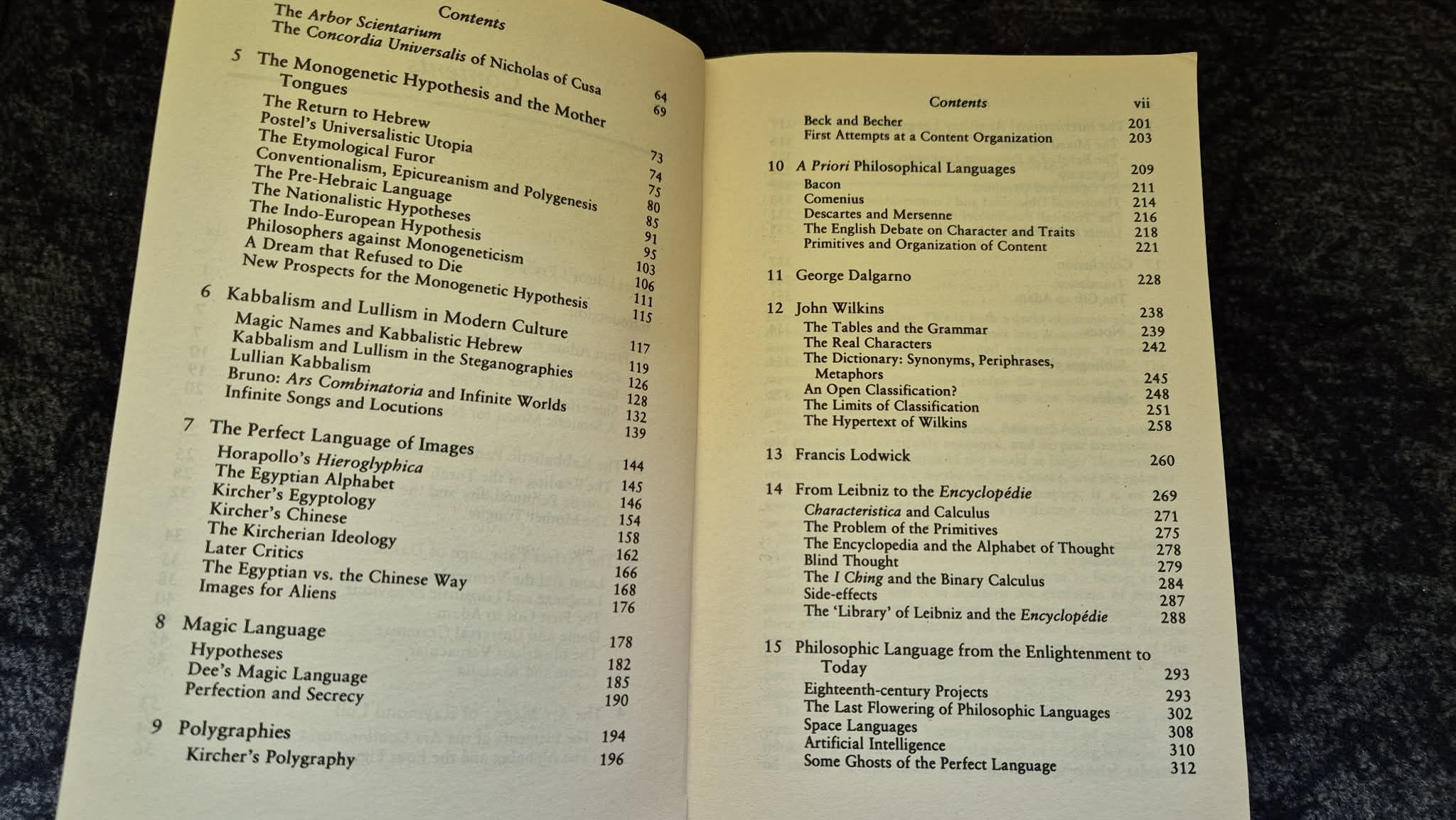
    A selection from the index of The Search for the Perfect Language

    Eco covers the entire history of the belief that language is handicapped by limitations, limitations that might (in some better world) be removed, taking us from the first chapters of Genesis to analytic philosophy. Would a better language remove the possibility of deception, of fake news? Would it cripple the Devil, who is the Father of Lies? Would it require a refinement of the soul, a dissolution of objective and subjective? There are no answers.

    The post The Search for the Perfect Language appeared first on Hermetic Kabbalah.

  • Backrooms

    John 14:2, “In my Father’s house there are many dwelling places.”

    At some point in the mid-90s I was in a convention centre in Belgium for a minor telecoms conference. I think the venue might have been Le Palais des Congrès de Liège. We were inventors. We were exhibiting a PTSN telecom switch hooked-up to a very new-fangled WWW server.

    Much of the convention space was shuttered and unused. I wandered off and discovered the Backrooms – halls, corridors, rooms, toilets, theatres – beige spaces empty of people, but still showing signs of occupation. Stacks of chairs, unused tables, display boards with old posters. Always, essentially, quintessentially, one flickering fluorescent light.

    It was spooky and unsettling. I was abnormally disturbed, and I made note of that. I began to take an interest in similar spaces, such as large underground car parks, and the concept of liminality.

    In 1991 the 3D version of Castle Wolfenstein was released, and because of technical limitations it featured a small palette of spaces and visual elements. These were combined to create (for the time) a satisfying experience of novelty. In retrospect we can recognise how much these early games reproduced the experience of the Backrooms. Various game-level editors were created for Doom, and it was possible to create and navigate spaces that were visually congruent to the Backrooms (as the concept stabilised into a definite spatial theme).

    Another idea culled from early games was clip-out and :no-clip. A developer who wanted to inspect the geometry of the game from the outside could set an option that would enable their first-person view to move through walls and other boundaries. Sometimes this would happen during gameplay, and the player would find themselves outside the game. For the gnostic, :noclip is the ultimate liberation from reality.

    I forget how I discovered references to the original Backrooms creepypasta. I was probably searching the Web for various ideas around the concept of liminality. I recognised instantly the canonical image, a photo from a claimed genuine furniture warehouse in Wisconsin. I was shocked to recognise something I thought private to myself. Wow. It was clear that many people had experienced a moment of recognition.

    I began to think about what I now term “low-entropy spaces” – that is, spaces that can be generated from a small number of simple rules. The Mandlebrot and Julia sets are a good example, as are spaces in early games like Wolfenstein. Crystalline structures, mazes …

    Where does the horror come in? Why are the Backrooms so creepy? The prototype might be the Cretan labyrinth with the Minotaur at its heart, but consider The Willows, a famous 1907 horror short story by Algernon Blackwood. Two adventurers are canoeing down the Danube and enter a vast delta-like area with innumerable small channels, and sandbanks covered with stunted willows. As far as the eye can see: channels, sandbanks, stunted willows, an archetypal low-entropy landscape. Thin ingredients for an acclaimed horror story, but H.P. Lovecraft, master of cosmic horror, dubbed it “the finest supernatural tale in English literature”. Many of the ideas were repurposed for T. Kingfisher’s 2020 novel, The Hollow Places.

    We experience much of the inherent spookiness of the Backrooms in The Shining, as Danny pedals his tricycle around the corridors of the Overlook Hotel. It’s the repetition, the elongated perspectives, the sense that the space is ontologically unsound and “we’re not in Kansas anymore”.

    Low-entropy spaces are creepy. I’ve experienced something akin to The Willows in the interior of Western Australia – the land as flat as a drafting table, the road a straight line that runs from horizon to horizon, and a single low bush replicated a near-infinite number of times. Inhuman. Disturbing.

    So what did I think of the 2026 movie? It follows the core ideas of the creepypasta at the beginning, but it goes off the rails. An opportunity for genuine ontological horror turns into the most generic cliche imaginable. I was hoping for something more like the Navidson House in the House of Leaves. A big fail IMO. There is another, far more disturbing film waiting to be made.

    The post Backrooms appeared first on Hermetic Kabbalah.

  • New Site

    If you are new to making a website, then you will find so many hosting providers offering wizard tools to help you get up and running. Making a new site is relatively easy compared with ten years ago, twenty years ago, thirty years ago.

    But are you locked in? What control do you have over the framework you are using, all these clever click-button tools? What happens when the provider goes out of business (or more likely) is absorbed into another company with a different approach?

    Making the site may be easy, but keeping it going for 10 years in the face of constant technical updates and infrastructure replacements is another matter. Keeping it going for 31 years is an achievement, and I’m going to brag about it. This site is 31 years old.

    I began this site in 1995, and it was carved out of a solid block of HTML using copper chisels and a grinding paste made of sand and bitter tears. Despite being a thing of consummate ugliness, it was popular.

    In 2011 I obtained a solid block of PHP and Javascript and began again. I’m a one-man band who does this for love, not money, and it sufficed … for the day. It wasn’t pretty. I wrote a large quantity of new content which eventually found its way into a book. Check out my publications.

    Now it is 2026 and the 2011 site was looking pathetic. Network Solutions was charging me an arm and a leg for hosting it. I had to migrate the domain, the content, and throw it all into WordPress. I’d never used WordPress.

    It is not a thing of beauty … but it will suffice. There will be bugs and broken links, but I will catch them. I see that many items are far too long and TLDR – I need to condense. Navigation needs work – I’ll fix it.

    A lot has happened in my life (four books, grandchildren, turning seventy-five). I have things to say. I expect to post new content.

    Please look in from time to time – I promise it won’t be boring.

    The post New Site appeared first on Hermetic Kabbalah.

  • Tarot and the Death Trump

    After a delay of three years I have finally made another Tarot video, on
    Tarot and the Death Trump

    The post Tarot and the Death Trump appeared first on Hermetic Kabbalah.

  • Drained

    We have had a very hot summer. The grass is bleached. Reservoirs and rivers are drying up. I have been feeling quite listless. The West of England has been cooler than the counties to the East, but even so, the heat is taking its toll on my energy.

    Finishing Liber Sphaerae in May was quite a push. I caught two nasty colds, then at the beginning of June I caught Covid, and that triggered a long-standing auto-immune thing. I spent a lot of June and July lying down.

    When not lying down I spent my time fixing a twenty-year old sportsbike, a 2002 Honda Fireblade. It had many things wrong with it. If you want to see me on the (now-working) bike, then
    Honda Fireblade 954: World Going Backwards – YouTube

    I cast around for a new writing project, but the feelings of listlessness triumphed. I read a vast swathe of books. If the weather cools down I will review some of them. I have completed 75% of a new video, but listlessness has claimed that too.

    We are so dependent on our energy. Listlessness isn’t merely a lack of get-up-and-go. It is a lack of the creative energy to do good things. One’s Muse goes on vacation. One can labour assiduously and produce pedestrian rubbish.

    Here is a picture of Hesiod and the Muse. You can imagine me without a mountainous view … and no Muse.

    The post Drained appeared first on Hermetic Kabbalah.