The Sefer ha-Zohar, or Book of Splendour, is not a book that I was ever able to read and understand easily. For more than thirty years, I have kept returning to the Zohar through different translations and editions, different commentaries, and different stages of my own life. Each encounter has revealed something new, but it has also made the text stranger.
Part of the problem is that there isn’t really one single Zohar. There is the very peculiar Aramaic text itself from the time it was written, the many layers of mystical speculation on its meaning, the commentaries surrounding it, the scholarly interpretations, and then the various attempts by translators to make something comprehensible out of a work that often seems determined to resist easy explanation. Every translation creates a different doorway into the same labyrinth.
My first encounter with the Zohar was in the early 1990s, when I was studying Philosophy and Theology and writing my dissertation on The Continuing Significance of Kabbalah. I wanted to properly understand what Kabbalah was and why it remained important beyond Orthodox Jewish communities, particularly within the Western esoteric tradition.
At that point, I knew little about the history of Kabbalah. I was approaching it with curiosity rather than expertise, reading anything I could get my hands on. The Zohar was evidently one of the central texts because so many later ideas about Kabbalah seemed to lead back to it. The problem was that, at the time, there was not all that much available in English.
I had a copy of S. L. MacGregor Mathers’ The Kabbalah Unveiled, which contained translations of several important sections of the Zohar. It was helpful, but it was also several steps removed from the original, having been translated into English from a Latin version rather than directly from the Aramaic.
I also had Gershom Scholem’s small anthology Zohar: The Book of Splendour, which offered selected passages and a glimpse into the wider world of the text. They were tantalising glimpses rather than a complete encounter. And perhaps that was appropriate. The Zohar is a text that seems to arrive in fragments. You don’t so much master it as gradually become more familiar with its landscape. I should mention that throughout all this, Gershom Scholem’s Major Trends in Jewish Mysticism was essential in helping me understand that the Zohar did not exist in isolation. It belonged to a historical world, with particular ideas, influences, and developments.
For my dissertation, I spent time in the private library of the painter Robert Lenkiewicz. He had built up an extraordinary collection of books on philosophy, religion, psychology, and the occult, including rare manuscripts and esoteric works. The first time I visited, he actually locked me in the library while I was working so that he could be sure I wasn’t making off with any priceless manuscripts.
While I worked, Lenkiewicz would sometimes come in and tell me stories. At the time, I didn’t always realise that these were not just anecdotes but attempts to communicate something about the subject itself. One story has stayed with me. He told me that, as a teenager, he had approached an old rabbi who was reputed to have great knowledge of Kabbalah. Lenkiewicz told me he had immediately launched into an impertinent question about the sephirah Din, or Gevurah. The rabbi responded by forcefully shouting, “No! No! No!” The young Lenkiewicz interpreted this as a refusal to engage with him because of his arrogance. Later, he came to realise the rabbi had deliberately demonstrated the very quality of Gevurah itself: boundaries, limitation, strength, and judgement. Whether the story happened exactly as told is beside the point. It captures something important about Kabbalah: that its ideas are not simply abstract concepts. They are ways of perceiving and engaging with reality.
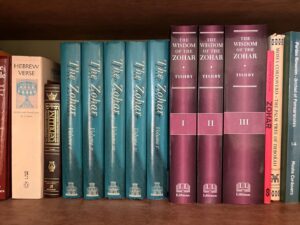
Lenkiewicz’s library was fantastic, but I also needed something substantial I could read at home. That came, via the magic of inter-library loan, through the five-volume translation by Harry Sperling and Maurice Simon. The Sperling and Simon edition was the first time I felt I was really entering the world of the Zohar. It was not the entire Zoharic corpus, but it was a substantial selection and, at the time, one of the most accessible ways into the work. The translation has a particular quality. It is, I think, quite beautiful and poetic, but it also smooths out some of the strangeness of the original. The Zohar can be, by turns, dense, awkward, repetitive, surprising, and downright bizarre. Sperling and Simon often transform that into something more flowing and literary. In some ways, this made the text easier to approach. In other ways, it concealed some of what makes the Zohar so fascinating. I would read passages and then sit with them for hours. A single page could send me down a rabbit hole of symbolism and speculation. I would try to work out what was happening, what the imagery meant, how the different divine attributes related to each other. It felt like trying to crack a nut with an impossibly hard shell.
Eventually, I bought my own copy of the Sperling and Simon Zohar set from Bob Gilbert’s Wise Owl Bookshop in Bristol for around £50. That was a huge amount of money for me in the 90s, when I was living very frugally. Bob wanted me to know that this particular 5-volume copy had belonged to someone who “knew their stuff”, because it contained pencil annotations throughout. Sadly, I eventually sold it when I was spectacularly skint, although I have subsequently replaced it with another edition.
Another crucial translation for me was Isaiah Tishby’s three-volume The Wisdom of the Zohar. Rather than being a complete translation, Tishby’s work is a thematic anthology of passages from the Zohar, accompanied by extensive explanatory notes. The danger with mystical texts is that it is very easy to treat them as collections of profound statements detached from their historical and cultural context, which is why commentary is helpful.
Then came the Daniel Matt Pritzker Edition. I had heard excellent things about it from someone who was collecting each volume as they appeared, but the books were expensive, and I couldn’t justify buying them one by one. Only after the complete twelve-volume set was completed did I finally take the plunge. The later volumes were completed by other translators, with Daniel Matt as general editor, but the whole edition was an extraordinary achievement. I still couldn’t quite justify the cost of the hardback set, which ran to several hundred pounds, so I read them all as eBooks instead. Perhaps one day, when I am in my dotage, I will finally acquire the physical set.
I spent around a year and a half reading through the entire translation carefully, making extensive notes as I went along. It was quite an undertaking. Some sections felt like crossing a desert. They were dense, repetitive, and stubbornly resistant to interpretation. Then, suddenly, there would be a moment of extraordinary brilliance: a shimmering jewel of thought, an unexpected connection, a flash of insight that made the whole journey worthwhile.
Matt’s translation is astonishing because it allows the Zohar to be strange again. It captures something easy to lose: the Zohar is not a neat system of mystical doctrines. It is a living, imaginative, sometimes chaotic conversation. The sefirot of the Tree of Life are not a static diagram. They are supernal beings in relationship, constantly shifting and interacting. The divine world of the Zohar is dynamic, and the spheres dance with each other.
Of course, coming back to an old text over several decades also means becoming aware of the troubling aspects. The Zohar contains some breathtakingly offensive passages. I became increasingly aware of its misogynistic elements and of how culturally distant the world of medieval Kabbalists is from my own. According to the Zohar, women are more evil than men because the Serpent filled Eve with its slime. It’s tempting either to dismiss old texts because they contain ideas we find unacceptable, or to romanticise them and pretend those problems are not there. Neither approach helps us understand them. The Zohar is a remarkable work of imagination and spiritual creativity, but it is also a product of a particular historical world, and both things can be true.
The strange thing about having come back to the Zohar in different translations over the years is that I don’t feel I have finally understood it. If anything, I understand better why it refuses to be understood completely. I am enormously grateful to all the translators who have devoted years of scholarship to bringing this extraordinary body of work into English. Translating the Zohar is not simply a technical exercise. It requires patience, sensitivity, and a willingness to spend years wrestling with something that constantly slips away.
And…having said this, the Zohar is not actually my favourite traditional Kabbalistic work by a long stretch, but more on that another time.
This post by Duncan Fleming first appeared on Substack